
There's a familiar story circulating in every software company right now. A team builds in three weeks what used to take six months. The client gets the same outcome, maybe better. Then the invoice goes out and the math falls apart. Faster delivery, less revenue. The industry rewards efficiency by punishing the people who achieve it.
This is real, and we felt it early. About 18 months ago, we saw AI-assisted development compressing our delivery timelines on integration projects. The same Apache Camel and Kubernetes work that used to fill a quarter could be done in weeks. Our clients were happy. Our margins were not.
That tension is what pushed us to build FastHub. Not because we wanted to launch a product for the sake of it, but because the commercial model underneath integration consulting was breaking, and no amount of clever pricing on hourly work was going to fix it.
The SaaS model assumes you do the work
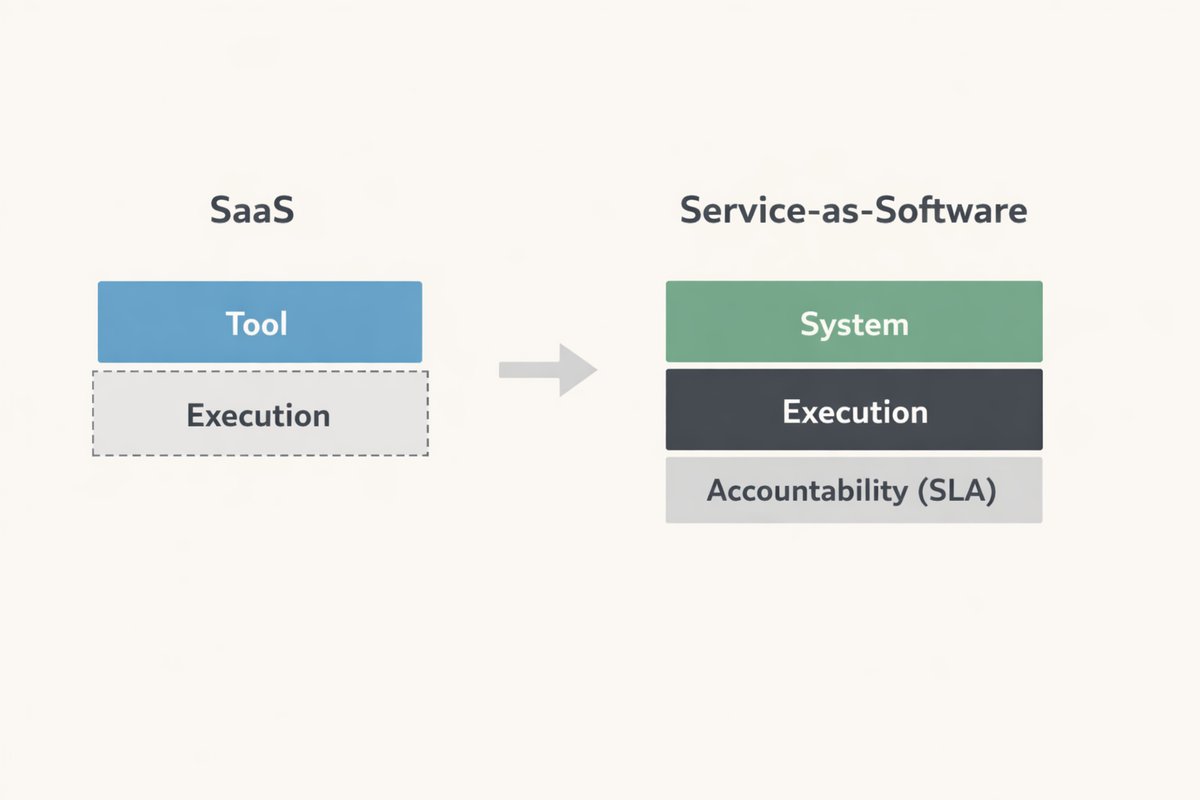
Most integration platforms today operate as SaaS. They sell you access to a tool: a visual designer, a connector library, a runtime environment. You pay per seat or per integration flow. Then you hire consultants to actually build, test, deploy, and maintain the integrations. The platform provides capability as a tool. The execution lives outside, in your team, your budget, your risk.
This made sense when building integrations was inherently manual. Someone had to understand the source system, the target system, the data formats, the authentication protocols, the error handling, and the business logic that ties it all together. That expertise was scarce, so it commanded high hourly rates. The platform was just the workbench.
But when AI can generate a working integration from a plain-language description, the workbench model starts to crack. The value isn't in providing the tool anymore. It's in providing the outcome.
When execution moves inside, accountability follows
This is the shift that matters, and it goes deeper than pricing models or delivery speed.
When a platform doesn't just host your integrations but generates them, runs them, monitors them, and maintains them, the execution moves inside the product. The product is no longer a passive tool waiting for a skilled operator. It participates in delivery.
And the moment execution lives inside the product, a new question emerges: who is accountable when something goes wrong?
In the old model, accountability was diffuse. The platform vendor was responsible for uptime. The consulting partner was responsible for the build. The customer was responsible for requirements and testing. When an integration failed in production, the finger-pointing could go in three directions.
In a Service-as-Software model, the answer is clearer. If the platform generates and runs the integration, the platform bears accountability for it working. That's a fundamentally different relationship with the customer.
SLA tiers are the pricing of responsibility
This realization reshaped how we think about FastHub's commercial model. We don't charge for the time it takes to build an integration, because AI has compressed that to near zero. We don't charge per seat, because the whole point is that one person can manage what previously required a team.
We charge for connectors, because complexity scales with the number of systems involved. And we charge for SLA tiers, because the level of accountability a customer needs varies dramatically.
A startup connecting a CRM to an invoicing tool needs the integration to work, but a few hours of downtime won't end the business. A manufacturer running real-time data flows across production systems in three countries needs a guarantee that someone picks up the phone at 2 AM.
The difference between those two scenarios isn't a feature gap. It's a responsibility gap. Our SLA tiers, from community support to dedicated 24/7 coverage, are priced accordingly. The customer isn't buying faster response times. They're buying a commitment from us to own the outcome.
What this looks like in practice
FastHub is an AI-native integration platform. A user describes what they need to connect in plain language. The AI generates the integration workflow using Apache Camel under the hood. The user reviews it, adjusts if needed, and deploys, either to our managed cloud or to their own infrastructure.
The pricing is connector-based with volume discounts. More connectors means a more complex environment, and the price scales with that complexity. Each tier (Free, Starter, Growth, Pro, Enterprise) includes a set number of connectors, a managed or self-hosted deployment option, and a corresponding SLA level.
This structure looks familiar on the surface. Tiers and connectors are concepts every buyer understands. But the underlying model is different from traditional iPaaS. The customer isn't buying a tool and then hiring people to operate it. They're buying working integrations, maintained and monitored, with a clear line of accountability back to us.
The trust layer that pricing can't solve alone
There's a dimension to this shift that pure pricing innovation doesn't address: trust.
When we tell a customer that AI generates their integrations, the immediate question is whether they can trust what the AI produces. Will it handle edge cases? Will it respect data residency rules across jurisdictions? Will it break silently?
This is why we built FastHub entirely on open-source components: Kubernetes, Keycloak, Open Policy Agent, Apache Camel, Quarkus. Every layer of the stack can be audited. No proprietary black boxes, no dependencies on vendors who might be subject to foreign government data requests. The platform runs on 100% EU-hosted infrastructure.
Open source isn't a feature bullet point. It's the foundation of a trust architecture. When a customer asks how they can verify that their data is handled correctly, the answer isn't "trust us." The answer is "read the code."
That matters especially in the European market, where sovereignty and compliance aren't abstract concepts but procurement requirements. But it matters everywhere. In a Service-as-Software model, where the vendor takes on execution responsibility, the customer needs to be able to verify that the system deserves that trust.
The gap between the conversation and the reality
The industry discussion around Service-as-Software, outcome-based pricing, and AI-native delivery is running ahead of where most buyers actually are. Most procurement teams still compare proposals by hourly rate and headcount. Most budgets are structured around time-and-materials assumptions. Most enterprises evaluate integration platforms by feature checklists, not by accountability models.
We don't expect this to change overnight. FastHub's pricing is designed to be legible in today's buying environment while being structurally aligned with where the market is heading. Connectors and tiers are familiar. The shift is in what happens after the purchase: less consulting, more capability, clearer accountability.
The companies that figure out this transition, not just in integration but across enterprise software, will be the ones that answer a simple question honestly: if your product does the work, are you willing to be responsible for the results?
We are. That's what the SLA is for.
FastHub is an AI-native integration platform built in Turku, Finland. It launches on April 1, 2026. Built entirely on open-source technologies and hosted within the EU, FastHub enables organizations to build, deploy, and manage integrations through natural language. Join the waitlist at fasthub.ai